Leave A Message
If you are interested in our products and want to know more details,please leave a message here,we will reply you as soon as we can.
submit
banner
Home

double shaft shredder knife

double shaft shredder knife

  • The Key Role of Dual Shaft Shredder Blades in Solid Waste Treatment
    Mar 05, 2026
    Dual shaft shredder blades are essential for solid waste treatment. They increase processing speed and aid resource recovery in three main ways:   Firstly, these blades drive efficient crushing. Solid waste, such as household garbage, industrial waste, and old appliances, varies in shape and hardness. High quality blades with sharp edges and well-designed teeth grip and cut materials, quickly shearing waste into uniform particles. Crushing efficiency rises 20%-30% compared to ordinary blades, shortening cycle times.   Secondly, high quality blades ensure consistent resource recovery. Their wear resistance and precision deliver uniform crushing, preventing over- or under-processing. As a result, they provide reliable raw materials for subsequent sorting and recycling, supporting processes like plastic regeneration and metal extraction. Consistent performance helps minimize secondary resource recovery costs.    Finally, this property is the cornerstone for stable operation. Dual-axis shredder machines use two parallel rotating shafts with intermeshing blades to cut materials. These shredders often run 24 hours a day. The blades must handle high impact loads during solid waste cutting. Blades made from high toughness, wear-resistant materials reduce chipping and equipment faults. This limits downtime, supports continuous operation, and reduces production losses.   Choosing the right dual axis shredder blades improves the efficiency of solid waste treatment. It also helps enterprises achieve reduction, harmless treatment, and resource recovery. These blades are indispensable to the waste treatment process.
    Read More
  • How to Maintain and Service the double shaft shredder blades
    Feb 28, 2026
      How to Maintain and Service the double shaft shredder blades: Daily Operation and Startup/Shutdown Procedures Before Startup: Ensure the cavity is free of foreign objects, check that the blade is securely fastened and well-lubricated, and confirm that the safety protection is in good condition. For new machines, immediately retighten the blade bolts 1 hour after startup. During operation, ensure materials are fed evenly. Avoid overloading. Do not add hard items such as metal. Monitor for unusual noises. Watch the current and output. Stop the operation immediately if you detect any abnormalities. After stopping, thoroughly clean leftover materials using a brush or compressed air to reach corners. Avoid harsh cleaners at all times. Cleaning and Lubrication Cleaning: Clear materials after each shutdown. Deep-clean the blade chamber and the blade every week. Remove adhered substances to prevent corrosion and damage to the blade edge. Lubrication: Once the blade is cleaned, apply anti-rust oil to prevent corrosion. Bearings, which are the rotating supports that reduce friction within the shredder, should be lubricated with lithium-based grease of NLGI 2 grade (the standard classification for grease thickness and hardness) every 100-500 hours. The reducer, a gearbox that slows the motor's speed to increase torque, should be filled with ISO VG 320 gear oil (an industry-standard viscosity grade) every 2000 hours, with oil temperature maintained at 45-80℃. Apply thread locking adhesive (a chemical that secures threaded fasteners) when tightening bolts. This prevents the bolts from loosening due to vibration or use.   Grinding Specifications: Use a dedicated grinding machine. For each grinding pass, do not exceed a 0.1mm stroke. Maintain the original blade angle. After grinding, check for and remove burrs, and ensure dynamic balance with an imbalance of within 0.5g·cm. Keep the imbalance within 0.5g·cm after removing burrs. Avoid using water cooling. Allow the blade to cool naturally to prevent cracking. Replace the blade if the width wear exceeds the allowed limit or if chipping is observed. Use both sides of double-sided blades. For thin material, set the gap to 0.8mm. Daily: Clear waste materials. Inspect blade damage and bolts. Listen for abnormal sounds. Check lubrication. Weekly: Deep clean. Sharpen dull blades. Check clearance and parallelism. Lubricate key areas. Monthly: Comprehensive inspection for wear, calibrate clearance, replace failed blades, thoroughly lubricate, and change oil (per schedule) New machine or major overhaul: Tighten blades 1 hour after startup. Complete comprehensive inspections and clearance calibration within 72 hours.  
    Read More
  • What materials are double shaft shredder blades made of?
    Feb 10, 2026
    Double shaft shredder blade material is a core component in solid waste treatment and resource recovery systems. It critically affects shredding efficiency, service life, operational reliability, and total cost of ownership. Four principal blade materials are widely adopted in industry today. Selection depends on waste composition, processing intensity, and operational needs.    SKD11 is a high-carbon, high-chromium cold-work tool steel. It is the most prevalent choice for general-purpose applications. With a hardness of HRC 58–60 and moderate toughness, it reliably handles medium- to low-hardness materials. These include plastics, rubber, paper, and light composites. SKD11 is cost-effective, and heat treatment and machining protocols are well established. Maintenance requirements are low. This material is suitable for small- to medium-scale recycling under standard duty cycles.     DC53 is an advanced cold-work die steel with superior mechanical properties compared to SKD11. After quenching and deep cryogenic treatment, it reaches a hardness of HRC 60–62. It also offers improved impact resistance and dimensional stability. DC53 is well-suited for high-intensity uses. These uses include rigid plastics, thin metals, and durable electronic housings. In continuous operation, DC53 blades last 30% longer than SKD11. This makes DC53 optimal for high-throughput, high-load production environments.    Material selection must be tailored to the feedstock and operational parameters. SKD11 is best for consistent, low-abrasion processing. Use DC53 for high-strength, high-cycle needs. Prefer H13 when thermal stress or metal content is high. Choose NM550 for very variable, impurity-rich waste streams. Matching materials to needs optimizes operations and lowers lifecycle costs.  
    Read More
  • Introduction of double shaft shredder blade
    Feb 02, 2026
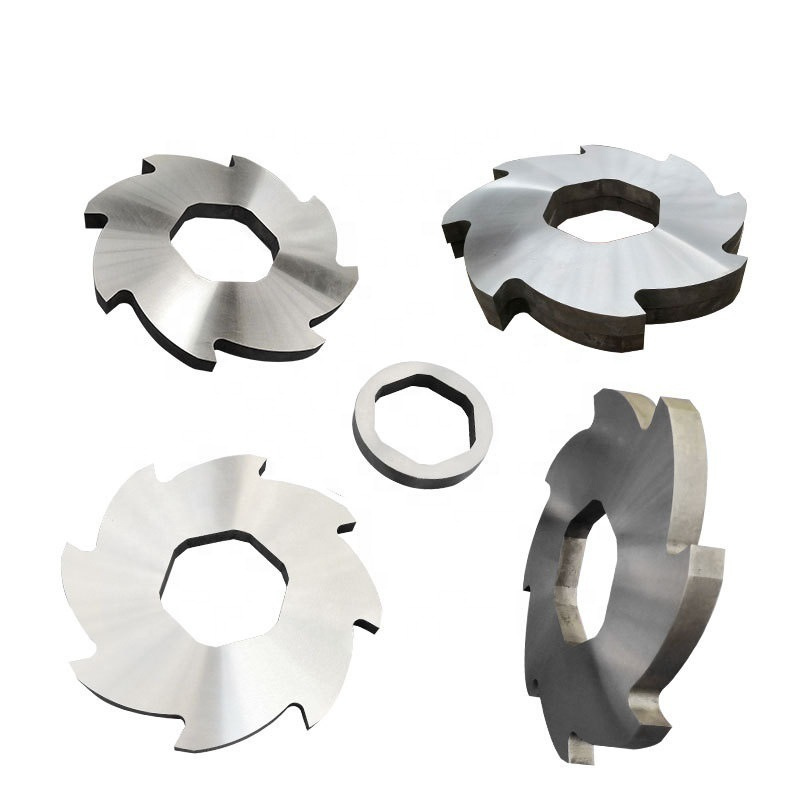
    The double shaft shredder blade is a key component designed specifically for double shaft shredders, used for efficient crushing and shredding of various waste materials. In industrial production, they determine the processing capacity and efficiency of shredders, especially suitable for the recycling and reuse of materials such as plastic, rubber, wood, and metal. The blades of a dual shaft shredder are usually disc-shaped with teeth, installed on two parallel shafts, and rotate in opposite directions to form a staggered interlocking shear structure. The blades are equipped with spacers to control the gap between the blades, thereby determining the particle size of the discharged material.  
    Read More
  • Summary of Shredder Blade Components
    Feb 02, 2026
    The shredder blade is the crucial component that determines a shredder's effectiveness and performance. Most blades are made from strong steel alloys with added elements like chromium, molybdenum, and vanadium to make them tougher and more durable. For applications that require greater hardness and heat resistance, hard-metal alloys are used. Depending on the materials being processed, blades come in three main shapes: hook-shaped, flat, and toothed. Each type is designed for shredding different types of material, such as fibrous, soft, or bulky items. Making these blades involves forging, casting, and heat treating the metal, followed by carefully grinding the edges on CNC machines to ensure sharpness and accuracy.     Our company designs and manufactures single and dual shaft shredder blades for industries including waste management, plastic recycling, metal processing, and wood processing. We use advanced automation and a certified quality management system (ISO 9001). Our blades are customized for each client’s material, feed speed, and lifespan needs, enhancing processing speed, reducing energy use, and cutting costs.
    Read More
Information
Get in touch
If you are interested in our products and want to know more details,please leave a message here,we will reply you as soon as we can.
submit
The Backbone of Customer Satisfaction

leave a message

leave a message
If you are interested in our products and want to know more details,please leave a message here,we will reply you as soon as we can.
submit
Contact Us: wen@aclshred.com

home

products

WhatsApp

CONTACT US